
Roofing lead tracking helps contractors identify which marketing channels generate inquiries and which leads eventually become paying customers. By combining website analytics, form submission tracking, phone call tracking, and customer relationship management (CRM) records, roofing companies can better understand where their leads come from and what happens after the initial inquiry.
But there’s a difference between tracking leads and knowing whether your marketing is actually working.
Let’s say you’re spending $5,000 a month on SEO, Google Ads, Local Services Ads, and other marketing campaigns.
Your phone rings. Homeowners submit quote requests. Your sales team schedules inspections.
That’s good.
But can you tell which marketing channel brought in those inquiries? More importantly, can you identify which ones resulted in actual roofing jobs?
If you’re only measuring website traffic, rankings, and the total number of leads, you’re missing part of the picture.
Before spending more on marketing, you need to understand what your current investment is producing.
Roofing Lead Tracking: 6 Steps to Identify Your Lead Sources
A practical roofing lead tracking system involves six steps:
- Set up Google Analytics 4 (GA4) to understand where website visitors come from.
- Track successful website form submissions so you know when someone actually sends an inquiry.
- Implement phone call tracking to identify genuine calls and their sources where possible.
- Use UTM parameters to distinguish traffic from different marketing campaigns.
- Connect leads to a CRM or spreadsheet to record qualification, estimates, and closed jobs.
- Test your tracking system regularly to verify that the information is accurate.
You don’t necessarily need expensive software to get started. What matters is having a consistent process for recording inquiries and connecting them to business outcomes.
What Is Roofing Lead Tracking, and How Does It Work?
Roofing lead tracking is the process of identifying where customer inquiries originate and recording what happens after those inquiries reach your business.
It involves three related activities.
Lead tracking identifies where an inquiry came from, such as Google Search, Google Maps, paid advertising, or a referral.
Lead attribution helps determine which marketing interactions contributed to the inquiry. A homeowner might discover your roofing company through Google, visit your website several times, and eventually call after seeing a recommendation from a neighbor.
Lead management follows the inquiry through the sales process, from the initial conversation to the inspection, estimate, follow-up, and completed roofing project.
These processes help answer three important questions:
- Where did the inquiry come from?
- Was it a qualified roofing lead?
- Did it eventually turn into a paying customer?
For example, your website might generate 30 form submissions in a month.
But what if 10 are spam, five are outside your service area, and another five are looking for services you don’t offer?
You didn’t really generate 30 qualified opportunities.
You generated 10 potentially relevant leads.
That’s why counting inquiries alone isn’t enough.
Why Isn’t Website Traffic Enough to Measure Roofing Marketing Performance?
Website traffic measures visits, not necessarily business opportunities.
An SEO agency might report that your roofing website’s organic traffic increased by 40%.
That sounds encouraging. But what happens if your phone isn’t ringing more often and your quote requests haven’t increased?
The additional traffic might be coming from people researching roofing materials, students looking for information, or homeowners outside your service area.
It doesn’t automatically mean the SEO campaign failed. But it does mean you need to investigate whether you’re attracting the right audience and whether those visitors can easily contact your business.
Attracting the right visitors is only part of the equation. Optimizing roofing websites for conversions can help turn more of those visits into legitimate roofing inquiries.
The same principle applies to paid advertising.
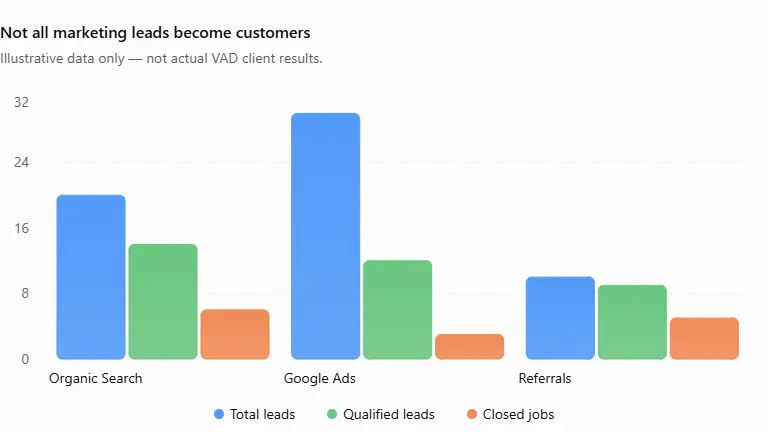
Consider this hypothetical example:
| Marketing Channel | Total Leads | Qualified Leads | Closed Jobs |
|---|---|---|---|
| Organic Google Search | 20 | 14 | 6 |
| Google Ads | 30 | 12 | 3 |
| Referrals | 10 | 9 | 5 |
Illustrative example only; these are not actual VAD client results.
Google Ads generated the most inquiries, but organic search produced more closed jobs. Referrals had the highest percentage of qualified leads.
Would you automatically increase your Google Ads budget because it generated 30 leads?
Not necessarily.
You’d want to know how much each channel costs, the value of the jobs it generates, and whether the results remain consistent over time.
The marketing channel generating the most leads isn’t always the one generating the most valuable customers.
This is also worth considering when comparing SEO vs. Google Ads for roofing contractors, since lead quality, acquisition costs, and long-term results can influence which channel deserves more investment.
That’s why roofing companies should measure lead quality and sales outcomes alongside traffic and inquiries.
Where Do Roofing Companies Get Their Leads?
Roofing contractors commonly generate leads through organic search, Google Maps, paid advertising, social media, referrals, and direct inquiries.
Each source requires slightly different tracking methods.
1. Organic Google Search
Organic search leads come from people who discover your website through unpaid search results.
For example, a homeowner might search for:
- Metal roofing contractors in their city
- Tile roof replacement services
- Roofing companies near them
- Residential roof replacement estimates
Google Search Console helps you understand which search queries generate impressions and clicks.
Google Analytics 4 can show how visitors reach your website and what actions they take after arriving.
If you’re unsure which search metrics matter, our guide to roofing SEO analytics and tracking explains how to evaluate your website’s organic search performance.
However, neither tool automatically tells you whether a visitor eventually signs a roofing contract.
You’ll need additional conversion tracking and sales records to make that connection.
2. Google Business Profile and Google Maps
Your Google Business Profile allows homeowners to find your roofing company through local search results and Google Maps.
They may call directly from your listing, visit your website, or request directions.
You can review Google’s Business Profile performance documentation to understand which customer interactions Google reports and how those metrics are measured.
Google Business Profile provides performance data about certain customer interactions, but those interactions aren’t necessarily unique, qualified leads.
For a more detailed explanation of these metrics, our guide to tracking local SEO performance covers how roofing contractors can evaluate their visibility in local search.
One useful approach is adding UTM parameters to your profile’s website link.
This can help distinguish website visits originating from your Google Business Profile from other organic search traffic.
You’ll still need to connect those visits to actual inquiries.
3. Google Ads and Local Services Ads
Google Ads and Local Services Ads provide their own performance reports.
But platform-reported conversions don’t automatically represent qualified customers.
A recorded conversion might be a form submission, a phone call, or another configured action.
You need to determine whether that interaction resulted in a legitimate roofing inquiry.
For example, your team might receive calls from suppliers, job applicants, or homeowners outside your service area.
Those interactions may appear in your reporting, but they shouldn’t automatically count as qualified sales opportunities.
4. Social Media and Referral Websites
Some homeowners discover roofing companies through Facebook, Instagram, directory listings, or third-party websites.
Campaign links with UTM parameters can help identify visits from these sources.
However, not every interaction is traceable.
Someone might see a roofing project on Facebook, remember your company name, and search for your business several days later.
Analytics may attribute the eventual visit to another source.
That’s one reason marketing attribution should be treated as useful evidence rather than a perfect record of every customer interaction.
5. Direct Traffic and Offline Referrals
Direct traffic is often misunderstood.
In Google Analytics, direct traffic generally means the system couldn’t identify a referring source for the visit. It doesn’t necessarily mean someone typed your website address into their browser.
Similarly, a homeowner referred by a neighbor might search your company name before calling.
A simple question during your intake process can help fill these gaps:
“How did you first hear about our roofing company?”
This won’t produce perfect attribution, but it can reveal information your analytics software doesn’t capture.
What Tools Do Roofing Companies Need to Track Leads?
You can build a basic lead tracking system using a combination of free analytics tools and your existing customer records.
| Tool | What it helps track | Important limitation |
|---|---|---|
| Google Search Console | Organic search queries, impressions, clicks, and rankings | Doesn’t identify individual leads |
| Google Analytics 4 | Website traffic sources and configured conversion events | Doesn’t automatically record completed phone calls or closed jobs |
| Google Tag Manager | Deployment and management of tracking tags | Isn’t a reporting or lead management platform |
| Call tracking software | Phone inquiries and available source attribution | Requires correct configuration |
| CRM or lead spreadsheet | Lead qualification, estimates, follow-ups, and closed jobs | Depends on consistent recordkeeping |
Not every roofing company needs every tool immediately.
Start by identifying what you’re already tracking and where information is missing.
How Do You Set Up Roofing Lead Tracking Step by Step?
Step 1: Verify Your Google Analytics 4 Setup
Start by checking whether Google Analytics 4 is installed correctly on your website.
GA4 can help you identify:
- Which marketing channels bring visitors to your website
- Which landing pages receive traffic
- How visitors interact with your website
- Whether configured lead-generation events occur
Google Tag Manager can make it easier to manage tracking implementations without editing your website’s code every time.
However, you don’t necessarily need Google Tag Manager for every website.
Before installing additional tracking, check whether GA4 or other tracking tags are already present.
Duplicate installations and incorrectly configured events can distort your reports.
Step 2: Track Successful Website Form Submissions
If your roofing website has a quote request or contact form, you should know when someone successfully submits it.
There’s an important distinction here.
A form button click isn’t the same as a successful form submission.
A homeowner might click Submit but encounter a required-field error. If your analytics records that click as a completed inquiry, your reports may overstate your leads.
For WordPress websites using Elementor, successful submissions can be tracked through an appropriate event integration or custom tracking configuration.
The exact implementation depends on your form setup.
Google recommends the generate_lead event for actions such as form submissions and requests for information. You can review the recommended event names and parameters in Google’s lead generation event documentation.
Once configured, submit a test inquiry and verify that:
- The form successfully submits.
- Your team receives the inquiry.
- The appropriate event appears in GA4.
- The event isn’t counted multiple times for the same submission.
A form submission should only be treated as a lead when the inquiry was actually received.
Step 3: Track Phone Calls, Not Just Phone Clicks
Phone calls are particularly important for roofing companies because homeowners may prefer speaking directly with a contractor.
You can configure analytics to track clicks on telephone links.
But a phone-link click doesn’t confirm that a call connected or that someone spoke with your team.
If phone inquiries are a major source of business, consider using dedicated call tracking software.
Depending on the provider and configuration, call tracking may help you measure completed calls, call duration, and marketing-source attribution.
Some systems use dynamic number insertion to display tracking numbers based on a website visitor’s source.
When implementing call tracking, preserve consistent business contact information across your local listings and follow applicable privacy and call-recording requirements.
The goal is to measure genuine inquiries rather than simply phone number interactions.
Step 4: Use UTM Parameters to Identify Campaign Traffic
UTM parameters are tags added to URLs that help analytics identify where campaign traffic originated.
If you’re setting these up for the first time, Google’s guide to UTM parameters explains how to structure campaign URLs and identify traffic sources consistently.
For example, a Google Business Profile website link could use:
This helps distinguish visits from your business profile from other organic search visits.
You can also use appropriately tagged links for email campaigns, social media promotions, and directory placements.
Keep your naming conventions consistent.
Using facebook, Facebook, and fb for the same source can make reports harder to interpret.
Also, don’t add UTM parameters to links between pages on your own website. That can interfere with attribution.
Step 5: Connect Your Leads to a CRM or Spreadsheet
This is where lead tracking becomes useful for business decisions.
Your analytics software may show that someone submitted a form.
But your sales team knows whether that person requested an inspection, received an estimate, or signed a contract.
You need a process that connects those records.
At a minimum, record the following information:
| Field | Example |
|---|---|
| Inquiry date | November 4 |
| Original lead source | Organic Google Search |
| Requested service | Metal roof replacement |
| Service area | City or ZIP code |
| Qualification status | Qualified |
| Appointment status | Inspection scheduled |
| Estimate status | Proposal sent |
| Job status | Won / Lost / Pending |
| Job value | Recorded when available |
You can begin with a spreadsheet if you don’t have a CRM.
What’s important is assigning someone responsibility for maintaining it.
Whenever possible, preserve the original lead source even if the customer interacts with your business again through another channel.
Step 6: Test Your Tracking Regularly
Tracking isn’t something you install once and assume will work forever.
Website updates, form changes, analytics configurations, and third-party integrations can affect your data.
Test the entire process.
Submit an inquiry through a tagged campaign link. Check whether the form reaches your team. Verify the event in analytics and confirm whether the source information appears in your lead records.
If you use call tracking, test that separately.
Then compare the inquiries recorded in analytics with the inquiries your team actually received.
The numbers may not match perfectly because of consent settings, browser restrictions, and other attribution limitations.
But significant discrepancies deserve investigation.
What Have We Learned From Reviewing Roofing Website Performance?
At VAD SEO Marketing, we start by examining a roofing company’s website structure, technical health, search visibility, and conversion opportunities.
We look at whether important service pages are accessible to search engines, how the website is organized, and whether visitors have clear ways to request an estimate.
We also review available search performance data to understand which pages and keywords are attracting visitors.
One challenge we’ve encountered is that website traffic and form submissions don’t always provide enough information to evaluate the entire marketing campaign.
A roofing website might be attracting visitors, but without reliable lead-source attribution, it’s difficult to determine which channels are generating those inquiries.
And without sales feedback, we can’t confidently connect those inquiries to closed roofing jobs.
That’s why we’re continuing to improve how we approach conversion tracking and reporting.
The objective is to move beyond reporting traffic and rankings toward a clearer understanding of qualified leads and business outcomes.
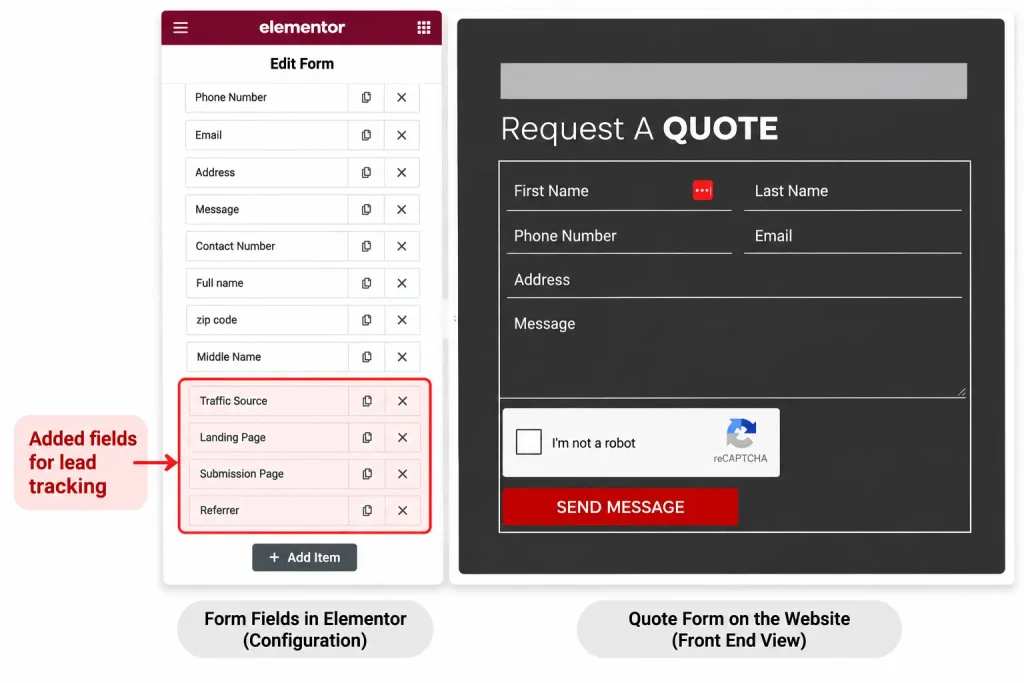
For example, when configuring a roofing client’s Elementor quote form, we added fields for traffic source, landing page, submission page, and referrer. These fields can help us understand how website inquiries originate when the tracking is configured and tested correctly.
It’s one part of building a more reliable lead tracking system, although we still need to connect that information to qualified leads and actual roofing jobs.
What Marketing KPIs Should Roofing Companies Track?
Once your lead tracking system is working, focus on metrics that help you make decisions.
Cost Per Lead
Cost per lead = Marketing spend ÷ Total leads
If you spend $2,000 on a campaign and receive 40 leads, your cost per lead is $50.
But that doesn’t account for lead quality.
Cost Per Qualified Lead
Cost per qualified lead = Marketing spend ÷ Qualified leads
If only 16 of those 40 inquiries meet your qualification criteria, your cost per qualified lead is $125.
This gives you a more meaningful measure of acquisition efficiency.
Lead-to-Customer Conversion Rate
Lead-to-customer conversion rate = Closed customers ÷ Total leads × 100
If 10 of 40 leads become customers, your conversion rate is 25%.
You can also calculate conversion rates specifically for qualified leads.
Just make sure your definitions remain consistent.
Customer Acquisition Cost
Customer acquisition cost = Total acquisition costs ÷ New customers acquired
Suppose your company spends $5,000 on marketing and acquires 10 customers.
Your simplified marketing cost per acquired customer is $500.
A complete acquisition cost calculation may also include sales-related expenses.
Remember that roofing projects can take time to close. A lead generated in one month might not become a paying customer until several weeks or months later.
For more accurate comparisons, track the outcomes of leads generated during the same period rather than assuming every month’s marketing spend directly corresponds to that month’s closed jobs.
What Are the Most Common Roofing Lead Tracking Mistakes?
Counting Every Inquiry as a Qualified Lead
Not every inquiry is a legitimate roofing opportunity.
Define what qualifies as a lead based on your service area, services offered, project requirements, and genuine customer intent.
Treating Phone Clicks as Completed Calls
Phone-link clicks indicate interest, but they don’t confirm that a conversation happened.
Use actual call records when measuring phone inquiries.
Assuming Direct Traffic Means Word-of-Mouth
Direct traffic may include visits with missing source information.
Don’t automatically classify it as referrals.
Counting the Same Prospect Multiple Times
A homeowner might submit a form and call the following day.
Without a consistent process, the same prospect could be counted twice.
Tracking Leads Without Tracking Closed Jobs
A marketing channel may generate many inquiries but few paying customers.
Without sales feedback, you risk optimizing for lead volume rather than business outcomes.
What Should a Roofing SEO Agency Include in Its Reports?
A roofing SEO agency should report more than keyword rankings and completed deliverables.
Its reporting should help the contractor understand what’s improving, what’s underperforming, and what needs attention.
At VAD SEO Marketing, our approach emphasizes regular communication, transparent reporting, and collaboration with our clients.
A useful weekly report should explain:
- Wins: Improvements in relevant search visibility, website performance, and measurable inquiries.
- Issues: Traffic declines, technical problems, underperforming pages, or delays.
- Completed work: SEO, content, technical, and conversion optimization tasks.
- Next steps: Priorities for the upcoming week.
- Client responsibilities: Information, photos, project details, approvals, or sales feedback needed to move the campaign forward.
Where reliable attribution and sales data are available, those results should also be included.
But this relationship works both ways.
Your SEO agency doesn’t answer your sales calls, conduct roof inspections, or close roofing contracts.
Your sales team may know that a particular campaign is attracting small repair inquiries when your company wants more full roof replacement projects.
That information can help the agency adjust its strategy.
Better marketing decisions require communication between the agency generating demand and the roofing company converting that demand into customers.
Frequently Asked Questions About Roofing Lead Tracking
How Can Roofing Contractors Track Where Their Leads Come From?
Roofing contractors can combine Google Analytics 4, tagged campaign URLs, successful form submission tracking, phone call tracking, and CRM records to identify lead sources. Connecting those inquiries to estimates and closed jobs helps determine which marketing channels contribute to actual business opportunities.
Can Google Analytics Track Phone Calls to a Roofing Company?
Google Analytics can track phone-link clicks when configured, but those clicks don’t confirm completed calls. Tracking actual phone conversations and their marketing sources generally requires a compatible call tracking solution or integration.
How Do You Track Leads From Google Business Profile?
Use a properly tagged website link to identify visits from your Google Business Profile. Combine that information with website conversion events, available Business Profile performance data, and call records to understand the inquiries associated with your listing.
What’s the Difference Between a Roofing Lead and a Qualified Roofing Lead?
A roofing lead is an inquiry from a potential customer. A qualified roofing lead meets your company’s criteria, such as service requested, geographic location, project suitability, and genuine interest in hiring a contractor.
Do Roofing Companies Need a CRM to Track Leads?
Not necessarily. A structured spreadsheet can work for smaller teams or companies establishing their tracking process. A CRM becomes more useful when you need to coordinate higher lead volumes, follow-ups, inspections, estimates, and sales outcomes.
Start With Roofing Lead Tracking Before Increasing Your Marketing Budget
If you’re already spending thousands of dollars on marketing but don’t know which channels generate qualified roofing leads, increasing your budget might not be the right first move.
Start by understanding what your current investment is producing.
Make sure your forms work. Track successful submissions. Establish a process for recording phone inquiries. Identify lead sources where possible. And connect those inquiries to estimates and closed jobs.
Once you have reliable information, you’ll be in a better position to decide which campaigns deserve more investment, which need improvement, and which may no longer be worth the cost.
If your current campaigns aren’t generating enough qualified opportunities, explore these practical ways to get more roofing leads before deciding whether to increase your marketing spend.
Because the goal isn’t simply to get more website traffic or phone calls.
It’s to generate more of the right opportunities for your roofing business.
Need Help Understanding Your Roofing Website’s Performance?
At VAD SEO Marketing, we help roofing contractors improve their online visibility through technical SEO, local search optimization, and website conversion improvements.
We start by understanding your website, your marketing goals, and the problems that may be preventing better results.
Contact VAD SEO Marketing to discuss your roofing website’s SEO and conversion performance.